Romford sits at the eastern edge of Greater London and is one of the largest towns in outer east London. It is not a quiet corner of the capital: it has a busy market, a substantial retail offer, and rail connections that have improved significantly since the opening of the Elizabeth line. It is also a town in transition, with a formal masterplan now adopted by Havering Council and significant development expected over the next fifteen years.
The town draws a broad range of buyers and tenants. Families are attracted by the typically more affordable prices compared with inner east London, the range of housing stock, and school provision across the borough. Commuters weigh up the Elizabeth line journey times against property prices that remain well below central London equivalents.
Landlords have been active here for years, attracted by consistent rental demand and a tenant base that spans young professionals, families, and long-term residents. The population has of Havering has grown by around 10% between the censuses in 2011 and 2021 and is projected to keep growing, which shapes both the market and the town’s infrastructure investment.
Why Live in Romford?
The strongest single argument for Romford is the combination of price and connectivity. Average sold prices sit at around £426,505 over the last year according to data from Rightmove, while the Elizabeth line now puts Paddington within 38 minutes and Canary Wharf within 28 minutes. For buyers priced out of Stratford, Forest Gate, or Ilford, Romford represents a meaningful step up in space and value without sacrificing access to central London.
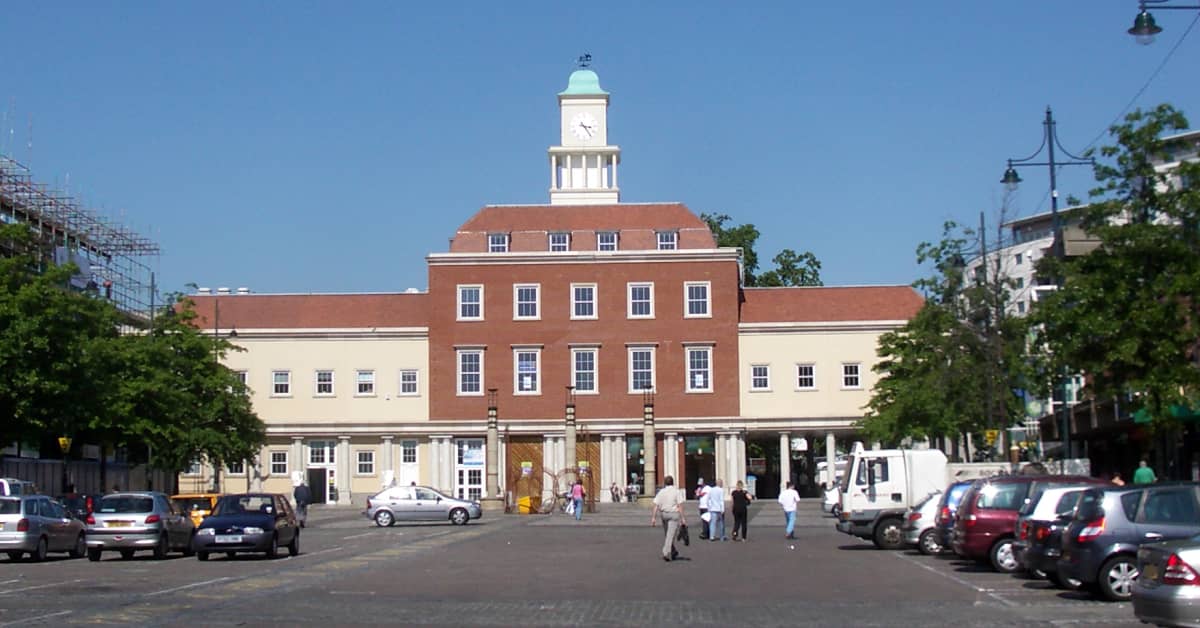
The twice-weekly outdoor market in the Market Place has operated for centuries and remains well-used. The Liberty shopping centre anchors the retail offer, and the Brewery leisure complex adds cinema, restaurants, and a gym to what would otherwise be a fairly conventional outer-London high street.
Got a Question?
Our team of experts is here to help in answering any query you may have.
The regeneration picture is also significant. Havering Council formally adopted the Romford Masterplan in March 2025, a sixteen-year framework that includes re-naturalising the River Rom, creating new walking and cycling routes, and delivering over 1,000 new homes near the station at Bridge Close. The Mayor of London’s designation of Romford as an Opportunity Area targets 5,000 new homes and 500 new jobs by 2041. For buyers and investors thinking about medium-term value, this is a town with a credible development pipeline.
Who Is Romford Best Suited To?
Buyer or tenant type
Best suited because
Potential drawback
Families
Range of house sizes, semi-detached and detached stock, school provision across the borough
Some schools are rated Requires Improvement; borough-wide school quality is uneven
Commuters to central London
Elizabeth line to Paddington (38 min) and Canary Wharf (28 min)
Bus frequency is lower than inner London; car dependency outside the town centre
First-time buyers
Prices below inner east London equivalents; new-build schemes in the pipeline
Stamp duty thresholds mean even entry-level homes attract some duty
Landlords and investors
Consistent rental demand, growing population, Opportunity Area designation
Crime rates above national average; some areas carry a higher level investment risk
Downsizers
Good flat and smaller property stock near the town centre; accessible amenities
Town centre can be busy; limited quiet residential pockets close to the core
Romford is less naturally suited to buyers seeking a quieter, lower-density setting: those priorities are better served by the outer Havering villages such as Upminster or Hornchurch, which sit within the same borough. Romford’s overall crime rate is above the national average, but this does not deter the majority of buyers.
Romford Property Market & Prices
The Romford property market spans a wide range of stock and price points, from one-bedroom flats in the town centre to detached four-bedroom houses in the outer postcodes. The average sold price across the RM postcode area stands at approximately £424,500 according to Rightmove, with most transactions completing in the £300,000 to £500,000 range.
The most affordable postcode sector is RM1 1, with an average of £231,000, while RM14 3 reaches £665,000 on Zoopla sales data for the last 12 months, reflecting the substantial difference between town-centre flat stock and the larger homes in Emerson Park and the Upminster fringe.
Newly built houses start from around £500,000 on developments such as Tring Gardens. Historical sold prices are down around 2% compared to the previous year, reflecting shifts in the wider property market.
For detailed analysis of specific streets, property types, and architectural character across the Romford postcodes, see the accompanying Romford Property & Architecture Guide and Romford Key Streets & Locations Guide.
Transport in Romford
Romford’s transport offer is built around its mainline station, which now sits on the Elizabeth line as well as the existing TfL Rail and Greater Anglia network. The connections are strong for a town of its size and position.
Mode
Route / Line
Approximate journey time
Elizabeth line
Romford to Canary Wharf
28 minutes
Elizabeth line
Romford to Liverpool Street
22 minutes
Elizabeth line
Romford to Paddington
38 minutes
Elizabeth line
Romford to Heathrow (T2/T3)
c. 65 minutes
Greater Anglia
Romford to Stratford
10 minutes
Road
A12 to central London / M25 (J28)
Variable
Bus provision within the town is functional but less frequent than inner-London equivalents, making a car useful for residents whose daily trips fall outside the rail catchment. The Romford Ring Road Scheme is developing improved walking and cycling connections between the town centre and surrounding streets, with the aim of reducing car dependency for shorter journeys. No new stations are currently planned for the immediate Romford area, but the Elizabeth line continues to consolidate the town’s commuter appeal.
Schools & Education in Romford
Romford sits within the London Borough of Havering, which has a range of primary and secondary provision. Ofsted ratings across the borough are mixed, and families should check individual school performance carefully.
Coopers’ Company and Coborn School, and the Royal Liberty School are among the options accessible to high-attaining pupils. Independent provision includes Gidea Park Prep School and Immanuel Primary School.
Local Amenities & Shopping in Romford
Romford offers a vibrant shopping area with many retail options. The Liberty shopping centre provides the main covered retail offer, with a mix of national chains across fashion, homewares, and food. A Marks & Spencer, Primark, and major supermarket operators including Tesco and Lidl serve everyday shopping needs, and the town is compact enough that most errands can be completed on foot from the station.
The outdoor market in Market Place, one of the oldest in the region, runs on Wednesdays, Fridays, and Saturdays and covers fresh produce, clothing, and general goods. It is a functional market rather than a boutique food hall, and it draws a loyal local following. The Brewery complex, a short walk from the market, adds a Cineworld cinema, gym, bowling alley, and a cluster of casual dining restaurants.
Watch: A simple walkthrough of Romford town centre to give you a feel for the area.
The Romford Masterplan proposes removing car parking from Market Place and investing in the public realm around the market, which should improve the pedestrian experience in the town centre over the coming years.
Restaurants, Pubs & Bars in Romford
Romford has a well-established reputation for its nightlife, particularly along South Street and the surrounding streets, which form one of east London’s busiest evening economy corridors. The concentration of bars and clubs draws a large Friday and Saturday crowd, which is worth factoring in if you are considering properties close to the town centre.
The food offer has broadened in recent years. The Brewery complex houses a number of national casual dining brands operating currently, including established chains covering American, Italian, and pan-Asian food.
Independent restaurants and cafés are dotted through the town centre and along the main approach roads, with a reasonable range of South Asian, Caribbean, and Eastern European options reflecting the borough’s demographic make-up. The Golden Lion pub on High Street is a long-standing local landmark serving traditional pub fare.
The main hospital serving Romford is Queen’s Hospital on Rom Valley Way, part of the Barking, Havering and Redbridge University Hospitals NHS Trust. It provides a full A&E department and a wide range of acute and specialist service. King George Hospital in Ilford is the other major acute site accessible to Romford residents, around four miles west.
GP provision across the RM postcodes is delivered through a number of surgeries, with several practices operating from the town centre and the surrounding residential areas. Dental access on the NHS is constrained, as it is across much of outer London, and patients should expect to join waiting lists for NHS dental registration. The CQC inspects and rates GP surgeries locally; the majority of practices in Havering hold a Good rating, though provision varies by practice.
Parks & Green Spaces in Romford
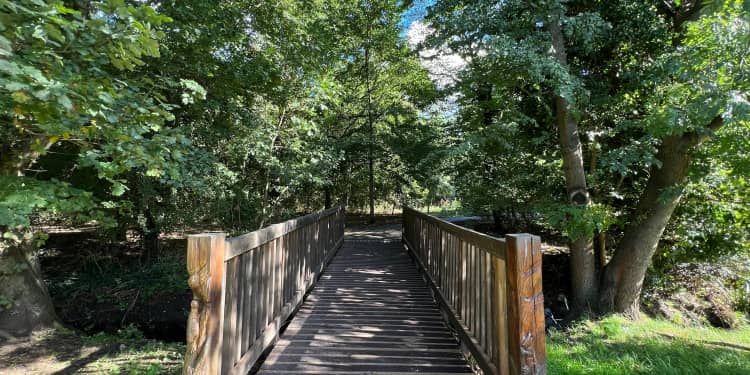
Romford is better served by green space than its town-centre density might suggest. Raphael Park, immediately east of the town centre, is the most significant local park: it includes a boating lake, formal gardens, a children’s play area, and open grass suitable for sports and dog walking. It is well-maintained and well-used by families and local residents.
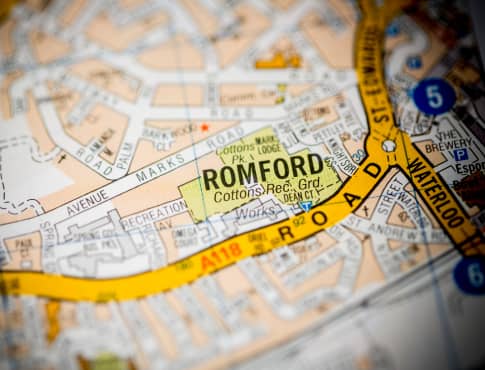
Cottons Park and Lodge Farm Park provide additional green space within the RM1 and RM3 postcodes, with the latter including playing fields and a skate area. Further out, the Havering Country Park to the north-east covers over 160 hectares of ancient woodland and open farmland, accessible by car or bus from the town centre. The planned re-naturalisation of the River Rom through the town centre, part of the 2025 Masterplan, would add a green corridor linking the park network to the station area.
Cost of Living in Romford
Council tax in the London Borough of Havering sits broadly in line with the outer-London average. Rental prices are significantly lower than inner east London equivalents: a two-bedroom flat in Romford rents at a level that would buy a one-bedroom flat in Stratford or Bow. For tenants and landlords, this relative affordability is one of the town’s defining characteristics. Car ownership adds cost for those living away from the station, as bus frequency makes some journeys impractical without a vehicle.
Approximate Rent in Romford
Property Types
Approximate Rent
Average monthly rent, 1-bed flat
£1,200–£1,400 pcm
Average monthly rent, 2-bed flat
£1,400–£1,700 pcm
Average monthly rent, 3-bed house
£1,700–£2,100 pcm
Council Tax Rates for Romford
Here’s what the council tax rates are for Romford residents between 2026/2027:
Council Tax Band
Standard Rate
Discounted Rate
A
£1,616.44
£1,212.33
B
£1,885.85
£1,414.39
C
£2,155.25
£1,616.44
D
£2,424.66
£1,818.50
E
£2,963.47
£2,222.60
F
£3,502.28
£2,626.71
G
£4,041.10
£3,030.83
H
£4,849.32
£3,636.99
Table showing council tax rates for Romford in 2026/27 – Always check council website for updates.
Community & Lifestyle in Romford
Romford has a strong sense of its own identity, rooted partly in the market, partly in its nightlife, and partly in the fact that it sits just across the old county boundary from Essex. Long-term residents tend to describe it as practical and unpretentious: a place where things work and where the amenity offering is good.
The town has an active calendar of events centred on the market and the Brewery complex, and Havering Museum on Market Place covers the local history of the borough. The arts and independent culture offer is modest compared with inner east London, but the Masterplan includes ambitions for cultural investment as part of the town centre regeneration.
Frequently Asked Questions
Is Romford a good place to live?
Romford works well for people who want space, reasonable property prices, and fast access to central London. The Elizabeth line has strengthened its commuter credentials considerably. It is a practical town rather than a fashionable one, which suits buyers and tenants who prioritise value and connectivity over neighbourhood prestige.
What are property prices like in Romford?
The average sold price across the Romford postcode area is approximately £424,500. Prices vary significantly by postcode: the town centre and flat-heavy RM1 sector is the most affordable, while the outer RM14 sector, covering Upminster and Emerson Park, reaches an average of £600,000.
Is Romford well connected by public transport?
By train, yes. The Elizabeth line provides fast and frequent services to Canary Wharf in around 28 minutes, Liverpool Street in 22 minutes, and Paddington in 38 minutes. Bus provision within the town is adequate but less frequent than inner London, so residents who live away from the rail corridor tend to rely on a car for local trips.
Is Romford safe?
Crime rates in Romford are above the national average, but violent crime has fallen by over 10% year-on-year, which is a meaningful improvement. Safety varies by street and postcode, so it is worth checking crime data at a local level when assessing a specific address.
Is Romford good for families?
Romford has a reasonable amount of family-appropriate housing stock, accessible green spaces including Raphael Park, and a spread of primary and secondary schools including ones rated Good or Outstanding. Families seeking larger homes tend to look at the outer RM postcodes rather than the town centre.
What is the rental market like in Romford?
Rental demand in Romford is consistent, driven by commuters, young professionals, and families who cannot yet buy. One-bedroom flats typically rent in the £1,200 to £1,400 pcm range, with two-bedroom flats running from around £1,400 to £1,700 pcm. These figures are notably lower than comparable stock in Stratford or Ilford, which makes Romford attractive for tenants stretched by inner east London rents.
Is Romford being regenerated?
Yes, and more concretely than many outer-London towns. Havering Council formally adopted the Romford Masterplan in March 2025, a sixteen-year framework covering new homes, improved public realm, cycling infrastructure, and the re-naturalisation of the River Rom. Over 1,000 new homes are planned for the Bridge Close site near the station, with construction expected to start in 2025. The Mayor of London has designated Romford an Opportunity Area targeting 5,000 new homes and 500 new jobs by 2041.
Looking for an Investment Property or New Home in Romford? We Can Help
Whether you are buying, selling, letting a property, or looking for a home to rent in Romford, Sandra Davidson’s team has detailed knowledge of the local market across every part of the RM postcodes. Contact Sandra Davidson to discuss what you are looking for, or visit the Sandra Davidson landlords page if you are exploring the rental market as an investor.
Share
Azeem S.
I began as a junior apprentice in a corporate estate agents in 2006 have been working in the property sector since, so over 14 years of experience. I have worked in a range of industries from Property sales and lettings, to construction, development, commercial sales and lets as well as facilities management and maintenance. I have a degree in Economics, enjoy keeping fit and healthy, support Man Utd and have a young family.
From affordable Victorian terraces near the town centre to spacious inter-war semis fetching close to £700,000 in the outer sectors, Romford offers one of outer east London’s most varied housing markets – but that variety comes with complexity. Whether you’re a first-time buyer, a growing family, or an investor, knowing which postcode, property era, and potential pitfalls apply to your purchase could make all the difference. This comprehensive guide covers everything from listed buildings to subsidence risks.
Here’s Why Romford’s Location Matters More Than You Think…
In Romford, two streets sharing a postcode and a five-minute walk can differ by over £100,000 in achieved sale prices. That gap isn’t coincidence — it’s driven by conservation boundaries, school catchments, Elizabeth line proximity, and architectural quality. From the dense town centre to Gidea Park’s protected Garden Suburb avenues and Emerson Park’s substantial private plots, getting the micro-location right here is everything. This street-by-street guide tells you exactly where to focus your search.
Discover the hidden gems of Redbridge with our guide to the top neighbourhoods and vibrant main streets in this diverse borough. Whether you’re seeking leafy suburbs, bustling shopping hubs, or cultural hotspots, Redbridge offers something for everyone. Uncover the best places to live, shop, and relax—plus insider tips on where to find the area’s finest cafes, parks, and local attractions. Dive in to explore what makes Redbridge a standout destination in East London!
This form collects and stores the information provided by you, so that we can contact you about your requirements. Please read our privacy policy for full information on how we manage and protect your submitted data.
This form collects and stores the information provided by you, so that we can contact you about your requirements. Please read our privacy policy for full information on how we manage and protect your submitted data.