

This form collects and stores the information provided by you, so that we can contact you about your requirements. Please read our privacy policy for full information on how we manage and protect your submitted data.
We use cookies and similar technologies to improve your experience, analyse site usage, and support advertising and personalisation. Find Out More
Newham is a large area of East London with a huge variety in property types and local amenities. If you are looking to buy or rent in Newham, understanding how values and lifestyle benefits vary from one location to another will help you to find the most suitable area to meet your preferences.
The property choices vary from the Victorian terraces of Forest Gate in the north to the waterside new-builds of Royal Wharf in the south. Two streets that are walking distance apart can differ significantly in price, character, and practical convenience. They often have different school catchments, different transport access, different planning histories, and different mixes of property type and tenure.
For buyers and tenants, knowing which roads fall within the most sought-after school catchments, which sit closest to Crossrail stations, and which are improving fastest can make a major difference. For sellers and landlords, understanding where your street sits within Newham’s internal geography is equally important, as it shapes what comparable evidence is relevant to your asking price or rental valuation.
This guide works through Newham, covering key roads, overlooked streets, the tenure picture – and more.
Newham’s highest-value streets are concentrated in Forest Gate and parts of Stratford, where Victorian and Edwardian housing stock is most intact and transport access is strongest.
Our team of experts is here to help in answering any query you may have.

Forest Gate produces the borough’s most consistently sought-after residential streets. Woodford Road and Capel Road, running north from Forest Gate station, are among the most well-known addresses in the area. Both are wide, tree-lined roads with substantial late-Victorian terraces and semi-detached houses that retain original features including bay windows, stained glass, and high ceilings.
The proximity of Wanstead Flats, one of the largest areas of open grassland in East London, adds further appeal. Forest Gate station, on the Elizabeth line, gives these streets a direct route to Liverpool Street in under fifteen minutes and to Heathrow in under an hour, which has supported prices since full Elizabeth line services began in 2022.
Sebert Road and Claremont Road, also in Forest Gate, sit within the same broad price bracket and attract buyers looking for slightly quieter roads with the same period character. Claremont Road in particular has a strong owner-occupier profile and a concentration of larger family houses with original features unusually well preserved.
In Stratford, the picture is more mixed but streets immediately adjacent to the Olympic Park tend to carry a premium for those who want new-build or converted stock with green space access and fast transport links. Here the premium is driven less by architecture and more by location and specification.
Green Street is the main commercial area but the residential streets directly off it, particularly those closest to Upton Park station, attract buyers priced out of Forest Gate who want a similar community feel at a lower entry point.
The streets commanding the clearest premium across the borough share a consistent set of drivers:
Newham divides into several distinct residential pockets, each with different price points, property types, and buyer profiles.
| Zone | Character | Who it suits | Price indicator |
|---|---|---|---|
| Forest Gate | Victorian/Edwardian terraces, tree-lined streets, strong owner-occupier base | Families, professionals, period property buyers | Highest in borough |
| Stratford | New-build and converted stock, excellent transport, regeneration-led | Young professionals, investors, commuters | Mid-to-high, new-build premium |
| Manor Park | Late-Victorian and Edwardian terraces, quieter, improving | Buyers seeking value with Elizabeth line access | Mid-range, rising |
| Plaistow | Mixed Victorian stock, strong rental market, multicultural | First-time buyers, landlords, tenants | Mid-range |
| Custom House/ Royal Docks | Largely post-war and new-build, waterside schemes, DLR and Elizabeth line | Investors, renters, new-build buyers | Variable; new-build at premium |
| Canning Town | Significant regeneration underway, mixed tenure, improving infrastructure | Investors, renters, buyers seeking regeneration uplift | Lower entry point, upward trajectory |
| Green Street / East Ham | Dense Victorian terracing, high rental concentration, active high street | Landlords, first-time buyers, tenants | Among the more accessible in borough |
Conservation areas in Newham include designations covering parts of Forest Gate and Manor Park, where local planning policy restricts unsympathetic extensions and alterations.
Buyers within these areas benefit from greater certainty that neighbouring properties will be maintained to a consistent standard, though they should be aware that permitted development rights are more limited. The Forest Gate conservation area in particular covers some of the most architecturally coherent Victorian streetscapes in the borough.
School catchments are a significant driver of demand in Forest Gate and Manor Park. The catchments for oversubscribed primary schools in these areas can shift year on year, and buyers relying on catchment proximity should verify the current position directly with specific schools or Newham Council’s admissions team before committing to a purchase.
Streets within half a mile of West Ham Church Primary School and St. Antony’s Catholic Primary School may attract buyer interest on catchment grounds, though catchment boundaries are not guaranteed to remain stable.
Price variation across Newham is driven by a clear set of factors, and the differentials between neighbouring streets can be significant. The borough spans a wide range and Forest Gate’s most sought-after Victorian terraces sit at the top of the market, while post-war stock in parts of Custom House and Green Street sits considerably lower.
Where sold price data is available at postcode level, it confirms the Forest Gate E7 postcode as consistently the borough’s highest-performing for terraced and semi-detached residential property. The E12 postcode, covering Manor Park, has shown the strongest price growth trajectory of any Newham postcode over the past three years as buyers priced out of E7 have moved east along the Elizabeth line corridor.
| Zone / Postcode | Property type | Approximate price range |
|---|---|---|
| Forest Gate (E7) | Victorian terraced / semi-detached | £556,713 |
| Manor Park (E12) | Edwardian terraced | £507,623 |
| Stratford (E15) | New-build flat | £482,533 |
| Plaistow (E13) | Victorian terraced | £408,835 |
| Canning Town (E16) | New-build flat / post-war | £417,602 |
| Royal Docks (E16) | New-build flat, waterside | £404,354 |
Figures are indicative ranges based on HM Land Registry sold price data at postcode level (HM Land Registry, 2026). Individual streets within each zone will vary. These are sold prices, not asking prices.
The key drivers of price variation within a single postcode are:
Newham has one of the highest private rental concentrations of any London borough. ONS Census data recorded a significant proportion of households in private rented accommodation across the borough, reflecting the combination of relatively affordable entry prices for landlords and strong tenant demand driven by the borough’s young population, as the median age is 32 years old.
| Area | Typical tenure | Typical buyer/tenant profile |
|---|---|---|
| Forest Gate | Owner-occupier dominant | Families, long-term buyers, period property purchasers |
| Manor Park | Mixed, shifting towards owner-occupier | Buyers priced out of E7, young families |
| Stratford/Olympic Park | High rental concentration, build-to-rent present | Young professionals, short-term renters, investors |
| Plaistow/Upton Park | Mixed, significant private rental | First-time buyers, landlords, families |
| Canning Town/Custom House | High rental concentration, new-build BTR | Renters, investors, key workers |
| Green Street/East Ham | High private rental | Tenants, landlords, first-time buyers |
Forest Gate stands apart from most of the borough in having a genuinely owner-occupier-led character on its best streets. Stratford and Canning Town, by contrast, have a high concentration of purpose-built rental stock, including build-to-rent schemes that have arrived with the regeneration wave.
For landlords, the strongest rental demand by is likely concentrated around Elizabeth line stations and the Stratford transport interchange, where tenant demand is expected and void periods tend to be short.
Several major development and infrastructure projects are likely to affect specific streets and micro-areas in Newham over the next five to ten years, and buyers should factor these into their location decisions.
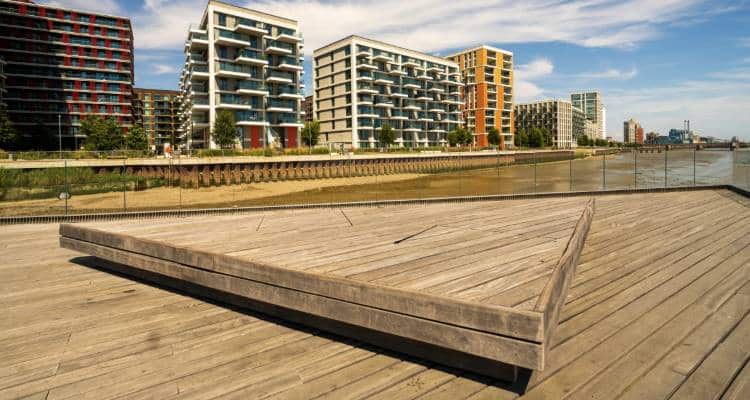
Silvertown is the most significant scheme currently progressing in the area. Newham Council’s Planning Committee approved a revised masterplan in December 2025 that will deliver nearly 7,000 homes, 30% of them affordable by habitable room, on the former Silvertown Quays site in the Royal Docks. Immediately alongside it, Thameside West, approved by City Hall in 2020 after Newham refused it, plans a further 5,000 homes, around 1,700 of them affordable. Both schemes will change the character of this stretch of waterfront substantially as they build out. For buyers in the immediate vicinity, that means improved public realm, new retail and leisure provision and better connections, alongside some disruption from construction activity.
The Silvertown scheme is supported by a £233 million Homes England infrastructure loan, announced in 2022, which helps fund the up-front enabling works on the site.
Canning Town’s regeneration is already well advanced. The transport interchange has served the area since the late 1990s, but the town centre around it has changed considerably since, with new retail and residential stock built close to the station. Newham’s wider Canning Town and Custom House programme continues, and further phases will keep improving the public realm on the connecting roads.
The Newham Leisure Centre site is the subject of an outline business case, commissioned in 2026, for housing, health and leisure uses. It forms part of a wider Health and Wellbeing Campus programme. The precise street-level impact will depend on the scheme design, so buyers near the site should monitor planning portal activity.
If you’ve used this guide to identify where in Newham you want to focus, whether as a buyer looking for the right street, a tenant weighing up pockets, or a seller or landlord wanting to understand where your property sits in the local market, Sandra Davidson can give you specific, current guidance based on the current local market activity.
Speak to the team via the Sandra Davidson contact page or request a property valuation to understand what your address is worth in today’s market.
The main price drivers at street level are Elizabeth line station proximity, the integrity and period of the property stock, conservation area designation, and green space access. A Victorian terrace on a tree-lined road within ten minutes’ walk of Forest Gate station, inside a conservation area, will trade at a significant premium over a similar-sized house on a more altered road further from the station, even within the same postcode.
Manor Park and Maryland are the two pockets most consistently identified by buyers who know the borough well as offering value relative to Forest Gate. Both have Elizabeth line access but trade at a discount to E7. Within Canning Town, the streets closest to the station interchange have improved materially with regeneration and offer a lower entry price with exposure to ongoing investment.
The Silvertown development, approved for around 7,000 homes with 30% affordable housing, will substantially change the character of the waterfront between Custom House and Silvertown over the next decade. Streets in this area will benefit from improved public realm and new amenity, but buyers should expect construction activity in the near term and should check the current planning position before purchasing.
It varies significantly. Forest Gate has a strong owner-occupier base on its best streets, while Stratford, Canning Town, and the Royal Docks are heavily weighted towards private rental and build-to-rent. For landlords, rental demand is strongest around Elizabeth line stations and the Stratford interchange, where tenant turnover is active and void periods tend to be short.
Based on 2026 sold price data, Victorian and Edwardian terraces in Forest Gate (E7) typically sell in the £550,000 to £750,000-plus range, while comparable stock in Manor Park (E12) sits broadly between £420,000 and £580,000. That gap has been narrowing as Elizabeth line awareness has drawn more buyers east along the corridor.
I began as a junior apprentice in a corporate estate agents in 2006 have been working in the property sector since, so over 14 years of experience. I have worked in a range of industries from Property sales and lettings, to construction, development, commercial sales and lets as well as facilities management and maintenance. I have a degree in Economics, enjoy keeping fit and healthy, support Man Utd and have a young family.
Newham is closer to the City than most people realise – and the Elizabeth line has made it closer still. Victorian terraces in Forest Gate, waterfront towers in the Royal Docks, post-war estates in Plaistow: the borough offers genuine variety, but quality varies enormously street by street.
Whether you’re a first-time buyer priced out of Hackney or an investor eyeing the regeneration pipeline, understanding exactly what you’re buying – and what to watch out for – could save you thousands.
Newham is becoming one of London’s most compelling places to live. Shaped by the 2012 Olympics and ongoing regeneration on a remarkable scale, it offers exceptional transport links, lower property prices than neighbouring boroughs, and a cultural diversity that few places can match.
But is it right for you? From Stratford’s Westfield and the Queen Elizabeth Olympic Park to the independent charm of Green Street, this comprehensive guide covers everything – schools, transport, green spaces, costs, and the honest trade-offs – to help you decide.
Barking has some of the lowest house prices in London – yet it sits on the Overground and District line and boasts one of the capital’s most active development pipelines. Whether you’re a first-time buyer, an investor, or a family seeking genuine space, understanding what you’re actually buying matters enormously. From solid-wall Victorian terraces to Gascoigne Estate regeneration schemes, this guide covers property types, conservation designations, period characteristics, and exactly what to check before you sign.
This form collects and stores the information provided by you, so that we can contact you about your requirements. Please read our privacy policy for full information on how we manage and protect your submitted data.